Lorena A. Barba group

Loading...
Reproducible validation and replication studies in nanoscale physics
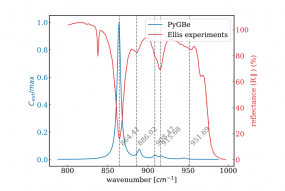
Preprint: arXiv 2008.05414, 12 Aug 2020. Submitted: July 27, 2020. Accepted: September 23, 2020. Published online: 29/03/2021 Published in print: 17/05/2021 Philosophical Transactions of the Royal Society A, 379(2197):20200068 (March 2021). https://doi.org/10.1098/rsta.2020.0068 Theme issue: ‘Reliability and reproducibility in computational science: implementing verification, validation and uncertainty quantification in silico’ – compiled and edited by P. V. Coveney, D.... Continue »
Lorena Barba is Jupyter Distinguished Contributor

At the closing keynote of JupyterCon 2020, Fernando Pérez introduced the inaugural class of Jupyter Distinguished Contributors, and Lorena Barba was among them! Project Jupyter established a "Distinguished Contributor" award in 2020 to recognize the work of contributors that is sustained over at least two years and is substantial in quality and quantity. Prof. Barba... Continue »
Computational nanoplasmonics in the quasistatic limit for biosensing applications
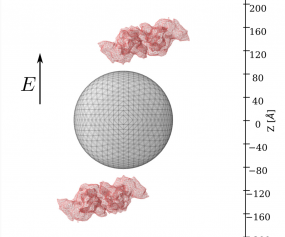
Preprint: arXiv 1812.10722 Dec. 31, 2018. Submitted: Dec. 31, 2018; Jan. 20, 2019; Mar. 20, 2019. Accepted: Nov. 1. Published: Dec. 16, 2019. DOI: 10.1103/PhysRevE.100.063305 Abstract This work uses the long-wavelength limit to compute LSPR response of biosensors, expanding the open-source PyGBe code to compute the extinction cross-section of metallic nanoparticles in the presence of any target... Continue »
Fulbright Scholar joins the group
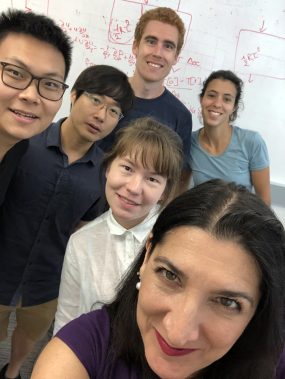
From left: Tingyu Wang, Pi-Yueh Chuang, Anastasia Sarmakeeva, Olivier Mesnard, Natalia Clementi, and Lorena Barba (Aug. 2019).
Reproducible workflow on a public cloud for computational fluid dynamics
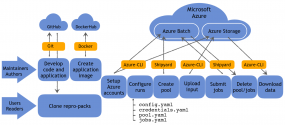
Submitted: April 18, 2019. Preprint: arXiv 1904.07981 Revised: Aug. 22. Accepted: Sep. 4. Published: Sep. 17, 2019 DOI 10.1109/MCSE.2019.2941702 Abstract In a new effort to make our research transparent and reproducible by others, we developed a workflow to run and share computational studies on the public cloud Microsoft Azure. It uses Docker containers to create an... Continue »
Prof. Barba gave keynote at PyData London
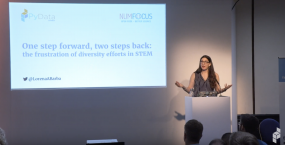
Prof. Lorena Barba delivers a keynote at PyData London 2019.