Lorena A. Barba group

Loading...
Reproducible validation and replication studies in nanoscale physics
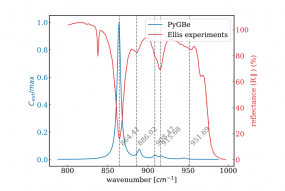
Preprint: arXiv 2008.05414, 12 Aug 2020. Submitted: July 27, 2020. Accepted: September 23, 2020. Published online: 29/03/2021 Published in print: 17/05/2021 Philosophical Transactions of the Royal Society A, 379(2197):20200068 (March 2021). https://doi.org/10.1098/rsta.2020.0068 Theme issue: ‘Reliability and reproducibility in computational science: implementing verification, validation and uncertainty quantification in silico’ – compiled and edited by P. V. Coveney, D.... Continue »
How repro-packs can save your future-self
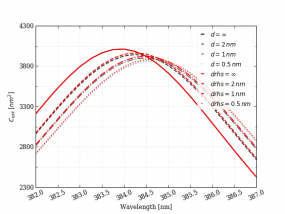
The story of a bug-fix after the research paper was published. Back in December 2019 we published a paper along with its reproducibility packages. These repro-packs, as we call them, consist of all the files necessary to reproduce the results in our paper (data and plots) and we deposit them in Zenodo and Figshare archives... Continue »
Reproducible workflow on a public cloud for computational fluid dynamics
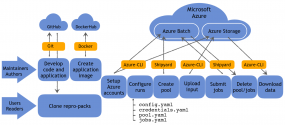
Submitted: April 18, 2019. Preprint: arXiv 1904.07981 Revised: Aug. 22. Accepted: Sep. 4. Published: Sep. 17, 2019 DOI 10.1109/MCSE.2019.2941702 Abstract In a new effort to make our research transparent and reproducible by others, we developed a workflow to run and share computational studies on the public cloud Microsoft Azure. It uses Docker containers to create an... Continue »
Lorena Barba interviewed at O'Reilly JupyterCon 2017
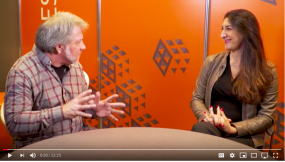
Highlights How I got started using Jupyter for teaching: I met Fernando Perez at a workshop, where he gave a talk about IPython notebooks, and immediately I knew I wanted to use this in my classes. I have used them in my classes ever since. First, in my Computational Fluid Dynamics (CFD Python) at Boston... Continue »
Nature TechBlog: My digital toolbox

Jeffrey Perkel, Technology Editor for Nature, interviewed Prof. Lorena A. Barba about her research group's reproducibility practices and the digital tools that enable them. She talked about the group's computational research interests, their avant-garde use of digital tools and repositories to create "repro-packs," and how these allow her to share research figures freely even when part... Continue »
Supercomputing Conference SC16: panel on reproducibility
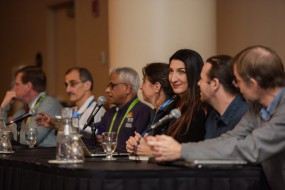
Prof. Lorena Barba participating in the SC16 panel "Different Architectures, Different Times: Reproducibility and Repeatability in High Performance Computing"