Biography
Speaker biography
(Can be used for speaking engagements at conferences and events; updated 2024)
Lorena A. Barba is professor of mechanical and aerospace engineering and international affairs at the George Washington University in Washington, DC, where she also serves as Faculty Director of the GW Open Source Program Office (OSPO). She holds a PhD in aeronautics from the California Institute of Technology and BSc/PEng degrees in mechanical engineering from Universidad Técnica Federico Santa María, Chile. Her research interests include computational fluid dynamics, high-performance computing, and computational biophysics, as well as computational reproducibility and open science.
An international leader in computational science and engineering, she is also a long‑standing advocate of open source software for science and education and is well known for her courses and open educational resources. She has a long track record of educational innovation and contributions to open education, recognized by the 2016 Leamer‑Rosenthal Award for Open Social Sciences and an honorable mention in the Open Education Awards for Excellence of the Open Education Consortium in 2017.
Dr. Barba served (2014–2021) on the Board of Directors for NumFOCUS, a 501(c)3 public charity that supports and promotes world-class, innovative, open-source scientific software, and was named a Jupyter Distinguished Contributor in 2020. She is an expert in research reproducibility, and was a member of the National Academies study committee on Reproducibility and Replicability in Science, which released its report in 2019. She served as the Reproducibility Chair for the SC19 (Supercomputing) Conference, was founding editor and associate editor‑in‑chief of the Journal of Open Source Software, editor‑in‑chief (and track editor for Reproducible Research) of IEEE Computing in Science & Engineering, and is editor‑in‑chief (and founder) of The Journal of Open Source Education. She was General Chair of the global JupyterCon 2020 conference.
Barba received the NSF Faculty Early CAREER award (2012), was named CUDA Fellow by NVIDIA Corp. (2012), is an awardee of the UK Engineering and Physical Sciences Research Council (EPSRC) First Grant program (2007), and was an Amelia Earhart Fellow of the Zonta Foundation (1999). In March 2022, she received the degree of Doctor Honoris Causa from her alma mater, Universidad Técnica Federico Santa María, the highest honorific awarded by the university.
See also:
http://about.me/lorenabarba
And on Twitter:
twitter.com/LorenaABarba
Photo:
https://www.dropbox.com/scl/fi/x9dapyukkldn9t17sn7u6/lorena.png?rlkey=8bxtcqh24qsd0hhpb4i5odaqw&dl=0

Education
- PhD Aeronautics (2004), California Institute of Technology, Pasadena, California (minor in French).
- MSc Aeronautics (1999), California Institute of Technology, Pasadena, California
- Title of professional Engineer — Ingeniero Civil Mecánico (1998), Universidad Técnica Federico Santa Maria.
- BSc Mechanical Engineering (1989), Universidad Técnica Federico Santa Maria, Valparaiso, Chile.
Personal biography
Lorena was born in Valparaíso, Chile. She is the oldest of three daughters of Jorge Eusebio Barba Gianotti (1940-1984) and Rosalinda Maritza Martinic Vrsalovic-Carevic. Commander Barba was an Officer of the Chilean Navy, and died in a civil aviation accident. Rosalinda lives in Reñaca, a lovely seaside town-like area of the tourist resort city Viña del Mar.
Lorena grew up in Viña del Mar. She and the family spent two years in Maryland, USA, while her father was appointed to the Chilean Naval Attaché in Washington, D.C. This meant learning English at an early age, which she ascribes as a determining factor in her future career success.
She received pilot training from her father since the age of 15 (not formally at first), then after obtaining the Student Pilot's Licence as soon as she turned 17 (the minimum age), logged her first solo flight. She was given a special award by the Naval Flying Club to finish her pilot training after her father's accident, and obtained her licence before starting University. The life-changing experience of becoming a pilot (including the many hours spent with the maintenance staff at the flying club, chatting and helping), determined her to a career in science and engineering.
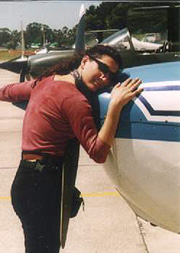
Lorena hugging the propeller of a Cessna 172 at Temuco airport.
Her first technical interest was aerodynamics, and she wished to be an aeronautical engineer. Unfortunately, no chilean university had a degree program in this subjec; only the Chilean Air Force did, but they did not accept women back then.
It would be several years later that Lorena participated in the opening of doors for women in Chile to be Air Force Officers, as she was invited to be part of the first program for women in the Air Force Reserve in 1995 (she holds the rank of Second Lieutenant, since 2001). Only 13 chilean women were invited to take part in this program, of which nine were private pilots. In 2001, for the first time women were able to participate in the general selection process of the Air Force Academy of Chile.